Tuesday Oct 13, 2026
Tuesday Oct 13, 2026
Tuesday, 13 October 2026 00:52 - - {{hitsCtrl.values.hits}}
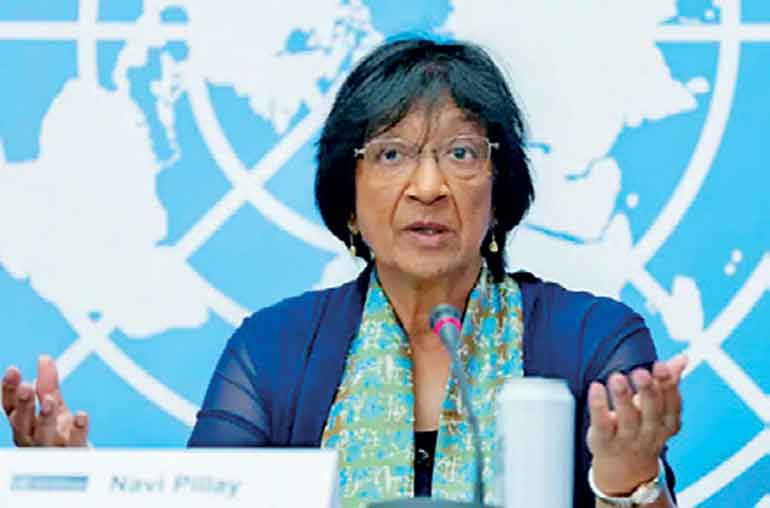
Navanethem (Navi) Pillay
Governing Council of the National Peace Council says the award of the 2026 Nobel Peace Prize to Navanethem (Navi) Pillay is a reminder to Sri Lanka of its unfulfilled human rights commitments.
The award recognises the South African jurist and former United Nations High Commissioner for Human Rights, and her lifelong commitment to human rights, justice and international law. The National Peace Council (NPC) congratulates Pillay on receiving this highest honour for her contribution to peace and the protection of human dignity.
Pillay’s commitment to human rights began in South Africa, where she challenged apartheid and defended Nelson Mandela and other anti-apartheid activists. As a judge of the International Criminal Tribunal for Rwanda, she helped establish landmark legal precedents recognising sexual violence as an act of genocide and a crime against humanity. As High Commissioner for Human Rights from 2008 to 2014, she championed accountability and the protection of fundamental freedoms. She currently serves on the bench of the UN’s highest court, the International Court of Justice. She was selected by The Gambia to sit as an ad hoc judge in its ongoing, high-profile case accusing Myanmar of committing genocide against the Rohingya minority.
Her award has particular significance for Sri Lanka. During her tenure, the country’s internal war and its aftermath came under scrutiny at the UN Human Rights Council. Her 2013 visit to Sri Lanka, and her assessment of the rule of law, militarisation, land and accountability, informed the 2014 Council resolution mandating an international investigation. She called for credible investigations, accountability and measures to address the grievances underlying the ethnic conflict, which became a significant part of international scrutiny of Sri Lanka. Unfortunately, seventeen years later her demands remain unfulfilled.
At the September 2026 session of the Human Rights Council in Geneva, the Sri Lankan Government called for time limits on country specific resolutions, including those concerning Sri Lanka. This position was taken in the context of the continuation of the evidence gathering and preservation mechanism on Sri Lanka, which the Government opposes. However, restricting the duration of international attention cannot substitute for addressing the concerns that gave rise to it. NPC urges the Government to implement recommendations made by Pillay and successive UN human rights processes which remain unfulfilled. These include credible investigations into wartime violations and enforced disappearances, protection of victims and witnesses, restoration of military occupied lands, demilitarisation of the north and east, reform of laws that undermine fundamental freedoms, and meaningful progress on truth, justice, reparations and reconciliation.
The Government also needs to address continuing concerns about civic space which have got aggravated through its envisaged laws namely, the Protection of the State from Terrorism Bill, the Prevention of Organised Crimes Bill and the NGO Registration and Supervision Bill.
The NPC pays tribute to Pillay’s contribution to the institutionalisation of international human rights law. Her Nobel Peace Prize is a powerful reminder that this framework must be defended and strengthened at a time when powerful countries increasingly disregard international law in pursuit of their own objectives. Whatever the constraints it faces, Sri Lanka, like all countries, has a responsibility to uphold these principles and fulfil its human rights commitments.




